Introduction
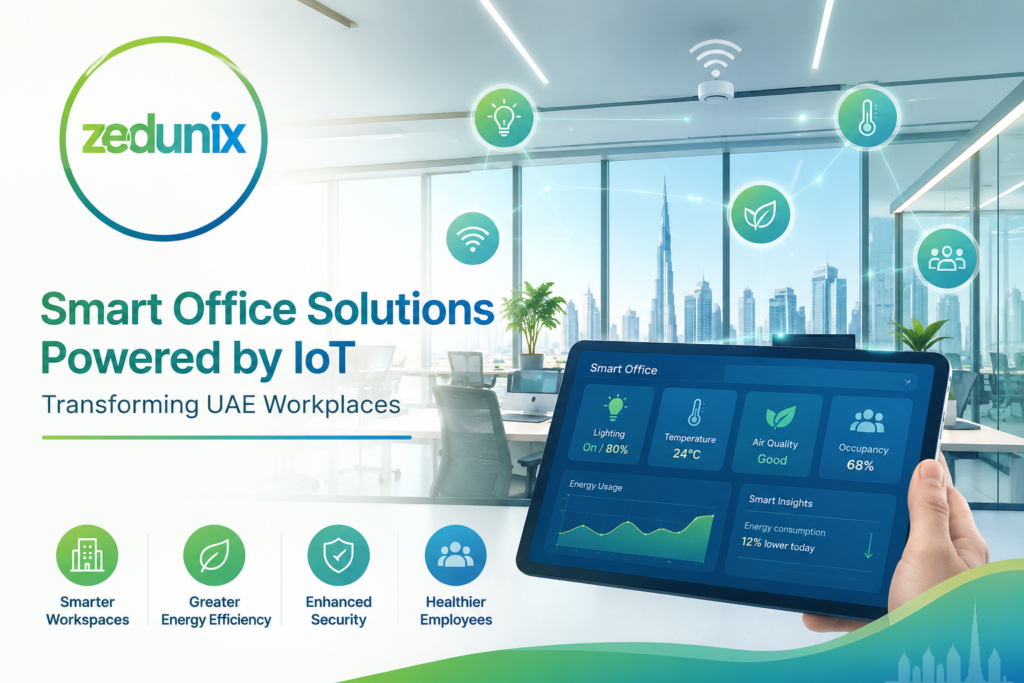
The UAE is rapidly becoming a global hub for digital transformation, smart infrastructure, and technology-driven businesses. From modern commercial buildings in Dubai to innovative workplaces in Abu Dhabi, businesses across the country are adopting Smart Office Solutions to create more connected, efficient, secure, and sustainable workplaces.
At the centre of this transformation is the Internet of Things (IoT). By connecting office devices, sensors, security systems, lighting, HVAC systems, meeting rooms, and workplace management platforms, businesses can collect real-time data and automate everyday operations.
For UAE businesses, smart office technology can be particularly valuable in areas such as energy management, workplace automation, building security, employee comfort, space utilization, and sustainability.
Whether you operate a corporate office in Dubai, a business centre in Abu Dhabi, a co-working space in Sharjah, or a growing enterprise elsewhere in the UAE, IoT-enabled workplace technology can help create a more intelligent and future-ready environment.
What Are Smart Office Solutions?
Smart Office Solutions use IoT devices, sensors, automation platforms, and connected technologies to manage and optimize workplace operations.
Instead of relying entirely on manual processes, a smart office can collect information from different areas of the workplace and use that data to automate actions.
For example, an office can:
- Automatically adjust lighting based on occupancy
- Control temperature based on room usage
- Monitor meeting room availability
- Track workplace occupancy
- Manage employee access digitally
- Monitor energy consumption
- Detect equipment issues
- Monitor indoor air quality
- Provide real-time workplace analytics
For UAE businesses managing modern commercial spaces, these technologies can support better operational efficiency while creating a more comfortable experience for employees and visitors.
What Is IoT in the Workplace?
The Internet of Things (IoT) is a network of physical devices equipped with sensors, software, and connectivity that allows them to collect and exchange information.
In a UAE office environment, IoT can connect multiple workplace systems through a centralized digital platform.
Common IoT devices used in smart offices include:
- Smart lighting systems
- Occupancy sensors
- Smart thermostats
- HVAC monitoring systems
- Smart access control
- Security cameras
- Air quality sensors
- Energy meters
- Smart meeting room systems
- Connected printers
- Digital workplace displays
- Smart parking systems
These devices generate real-time data that can help facility managers and business leaders understand how their offices are being used.
How IoT Powers Smart Offices in the UAE
A connected office brings different workplace systems together into a single intelligent ecosystem.
For example, occupancy sensors can detect when employees enter or leave a meeting room. The information can then be used to control lighting and temperature automatically.
Similarly, energy monitoring systems can identify areas of high consumption, while smart access control systems can help businesses manage who enters specific areas of a facility.
A typical IoT-powered UAE office may include:
Sensors → Connected Devices → IoT Platform → Data Analytics → Automation
This creates a workplace where decisions can increasingly be based on real-time information rather than assumptions.
Key Smart Office Solutions for UAE Businesses
1. Smart Lighting
IoT-enabled lighting systems can automatically adjust illumination based on occupancy, schedules, and available natural light.
Benefits
- Reduced unnecessary electricity consumption
- Improved employee comfort
- Automated lighting schedules
- Lights automatically switched off in unoccupied areas
- Remote lighting management
For UAE businesses operating large offices and commercial buildings, intelligent lighting can form an important part of an overall smart building strategy.
2. Intelligent HVAC and Climate Control
Climate control is particularly important for workplaces operating in the UAE’s hot environment.
Smart HVAC systems use sensors and connected controls to monitor factors such as occupancy, temperature, and environmental conditions.
The system can adjust cooling based on actual workplace requirements rather than operating at the same level throughout the day.
Benefits
- Better temperature management
- Improved employee comfort
- Reduced energy wastage
- Automated climate control
- Improved equipment monitoring
- More efficient facility management
For UAE businesses, intelligent HVAC management can be an important component of energy-efficient office operations.
3. Smart Meeting Rooms
Meeting rooms are becoming increasingly connected as UAE businesses adopt hybrid and digital working models.
Smart meeting room solutions can integrate:
- Digital room displays
- Automated room booking
- Occupancy sensors
- Video conferencing
- Wireless presentations
- Calendar integration
- Workplace analytics
Occupancy data can help organizations identify unused capacity and improve meeting room availability.
4. Smart Access Control
IoT-enabled access control systems provide organizations with flexible ways to manage employee and visitor access.
Technologies can include:
- RFID cards
- Mobile credentials
- Smart locks
- Biometric authentication
- Visitor management systems
- Integrated access platforms
Access permissions can be managed based on employees, departments, locations, or specific areas of a building.
5. Workplace Occupancy Monitoring
With hybrid work becoming increasingly common, businesses need to understand how their office spaces are being used.
Occupancy monitoring systems use sensors and analytics to provide insights into:
- Desk utilization
- Meeting room usage
- Employee traffic patterns
- Peak occupancy periods
- Underutilized spaces
- Workspace requirements
For UAE companies operating large offices, this information can support better workplace planning and space management.
6. Smart Energy Management
Energy management is one of the most important applications of IoT in smart buildings.
Connected energy meters and sensors can monitor electricity consumption across different areas of a workplace.
Businesses can use this information to:
- Identify energy-intensive areas
- Monitor consumption patterns
- Detect unusual usage
- Reduce unnecessary energy consumption
- Track operational performance
- Support sustainability initiatives
For organizations in the UAE looking to build more efficient workplaces, smart energy management can complement broader sustainability strategies.
7. Indoor Air Quality Monitoring
IoT sensors can continuously monitor environmental factors such as:
- CO₂ levels
- Temperature
- Humidity
- Air pollutants
- Ventilation conditions
Facility teams can use this information to identify areas that may require improved ventilation or environmental adjustments.
A healthier and more comfortable workplace can contribute to a better employee experience.
8. Predictive Maintenance
IoT enables businesses to move towards predictive maintenance, where connected equipment can provide data about its operating condition.
Sensors can monitor:
- HVAC equipment
- Elevators
- Generators
- Pumps
- Printers
- Electrical systems
- Building equipment
When unusual performance is detected, facility teams can investigate the issue before it develops into a major operational problem.
This can help businesses reduce unexpected downtime and improve equipment management.
Key Benefits of Smart Office Solutions in the UAE
Improved Operational Efficiency
Automation can reduce the amount of manual intervention required to manage everyday workplace systems.
Reduced Operating Costs
Smart office technology can help businesses identify inefficiencies in energy consumption, space utilization, equipment operation, and maintenance.
Better Employee Experience
Connected workplaces can provide comfortable temperatures, better lighting, easier meeting room access, digital collaboration tools, and improved indoor environmental conditions.
Enhanced Workplace Security
IoT-enabled security systems can connect access control, surveillance, visitor management, and real-time alerts.
Better Space Utilization
Occupancy analytics can help businesses understand how employees use different areas of their offices, which is particularly useful for hybrid work environments.
Supporting Sustainability Goals
Smart building technologies can help organizations monitor and manage resources more efficiently while supporting energy efficiency, resource optimization, and sustainable workplace operations.
Smart Office Solutions for Different UAE Industries
IoT-powered workplace solutions can be implemented across a wide range of UAE industries.
Corporate Offices
Large organizations can use IoT to manage energy, security, meeting rooms, and workplace occupancy.
Financial Services
Financial organizations can benefit from enhanced access control, monitoring, security, and facility management.
Healthcare
Connected building systems can support environmental monitoring, facility management, and security.
Education
Schools, colleges, and universities can use smart building technologies to manage classrooms, energy, security, and facilities.
Co-Working Spaces
Occupancy monitoring, smart access, room booking, and workplace analytics can help co-working operators improve space utilization.
Retail and Commercial Buildings
IoT can connect lighting, HVAC, security, energy management, and building operations.
Manufacturing and Industrial Offices
Connected monitoring systems can help manage administrative offices, facilities, energy usage, and equipment.
Smart Offices and the UAE’s Digital Future
The UAE continues to position itself as a technology-driven economy, making digital transformation an important consideration for businesses operating in the country.
As organizations modernize their workplaces, the Connected Office is becoming part of a broader shift towards smart buildings and digitally managed infrastructure.
IoT can connect workplace systems with centralized platforms, allowing businesses to move from reactive facility management towards more data-driven and automated operations.
For companies investing in new offices or upgrading existing facilities, smart technology can be considered part of a long-term Digital Workplace strategy.
Challenges of Implementing IoT in UAE Offices
While smart office technology offers significant advantages, businesses should carefully consider several challenges:
- Cybersecurity risks
- Data privacy
- Device compatibility
- Initial implementation costs
- Network infrastructure
- Ongoing maintenance
- Employee adoption and training
Proper planning, secure infrastructure, and reliable technology partners are essential for successful implementation.
Best Practices for Implementing Smart Office Solutions
Businesses planning an IoT-enabled workplace in the UAE should consider a phased approach:
1. Assess Your Workplace
Identify operational challenges involving energy, security, space, meeting rooms, or facility management.
2. Define Clear Objectives
Determine what the organization wants to achieve before selecting IoT technologies.
3. Start With High-Impact Areas
Lighting, HVAC, energy monitoring, access control, and occupancy management can be good starting points.
4. Choose Scalable Technology
Select solutions that can integrate with existing infrastructure and expand as the business grows.
5. Prioritize Cybersecurity
Use strong authentication, encryption, access controls, security updates, and continuous monitoring.
6. Integrate Systems
Where possible, connect different workplace technologies through centralized management platforms.
7. Monitor Performance
Use workplace analytics to measure whether the smart office is delivering the expected improvements.
Future of Smart Offices in the UAE
The next generation of UAE workplaces is likely to become increasingly intelligent and connected.
Emerging technologies include:
- Artificial Intelligence (AI)
- Machine Learning (ML)
- Digital Twins
- Edge Computing
- 5G connectivity
- Advanced workplace analytics
- Touchless office technology
- Voice-controlled automation
- Intelligent robotics
- Smart building management systems
AI and IoT can work together to transform workplace data into actionable insights, helping businesses optimize room allocation, energy usage, facility operations, and workplace experiences.
How to Choose a Smart Office Solution Provider in the UAE
Choosing the right technology partner is just as important as choosing the technology itself.
Businesses should evaluate providers based on:
- IoT and smart building expertise
- Integration capabilities
- Scalability
- Cybersecurity practices
- Cloud and network infrastructure
- Analytics capabilities
- Maintenance and technical support
- Customization options
- Experience with UAE businesses
- Long-term technology roadmap
A good smart office solution should not simply connect devices. It should help the business solve real workplace and operational challenges.
Transform Your UAE Workplace with Zedunix
Ready to make your workplace smarter, more connected, and more efficient?
Zedunix helps businesses embrace digital transformation with smart technology solutions designed to simplify operations, improve efficiency, and create future-ready work environments.
Whether you’re looking to improve workplace automation, optimize operations, or build a more connected digital workplace, Zedunix can help you explore the right technology approach for your business.
Make your workplace smarter with Zedunix. Get in touch with our team today to explore the right smart office solution for your UAE business.
Conclusion
Smart Office Solutions powered by IoT are transforming workplaces across the UAE.
From intelligent lighting and HVAC automation to smart access control, occupancy analytics, energy management, and predictive maintenance, IoT allows businesses to create workplaces that are more connected, efficient, secure, and adaptable.
For businesses in Dubai, Abu Dhabi, Sharjah, and across the UAE, investing in smart workplace technology can support operational efficiency while creating a better experience for employees and visitors.
As the UAE continues to embrace digital transformation and smart infrastructure, connected workplaces are likely to become an increasingly important part of the modern business environment.
The future office is not simply a place where people work. It is a connected digital ecosystem that can understand, respond, and continuously improve.