The UAE’s business landscape has changed faster than almost anywhere else in the world. Free zones, Emiratisation targets, VAT and corporate tax compliance, and a workforce spread across Dubai, Abu Dhabi, and Sharjah have pushed companies to rethink how they run their operations. At the center of that shift sits one question every growing business eventually asks: should we stick with the spreadsheets, registers, and standalone software we know, or move to an Enterprise Resource Planning (ERP) system?
This isn’t a trend question. It’s a practical one, and the answer depends on where a business is in its growth journey. Here’s a clear-eyed comparison to help UAE business owners and decision-makers figure out which approach actually fits.
What “Traditional Business Management” Really Means
Traditional business management usually isn’t one single tool — it’s a patchwork. A UAE SME might run:
- Excel sheets for inventory and budgets
- A separate accounting tool for VAT and tax filings
- Messaging apps and email threads for internal approvals
- A standalone POS system at the retail counter
- Paper-based or PDF HR records for payroll and visas
Each piece works on its own. The problem shows up in the gaps between them — when the sales team doesn’t know what finance is doing, or when a stock count in the warehouse doesn’t match what’s showing online.
What ERP Actually Does Differently
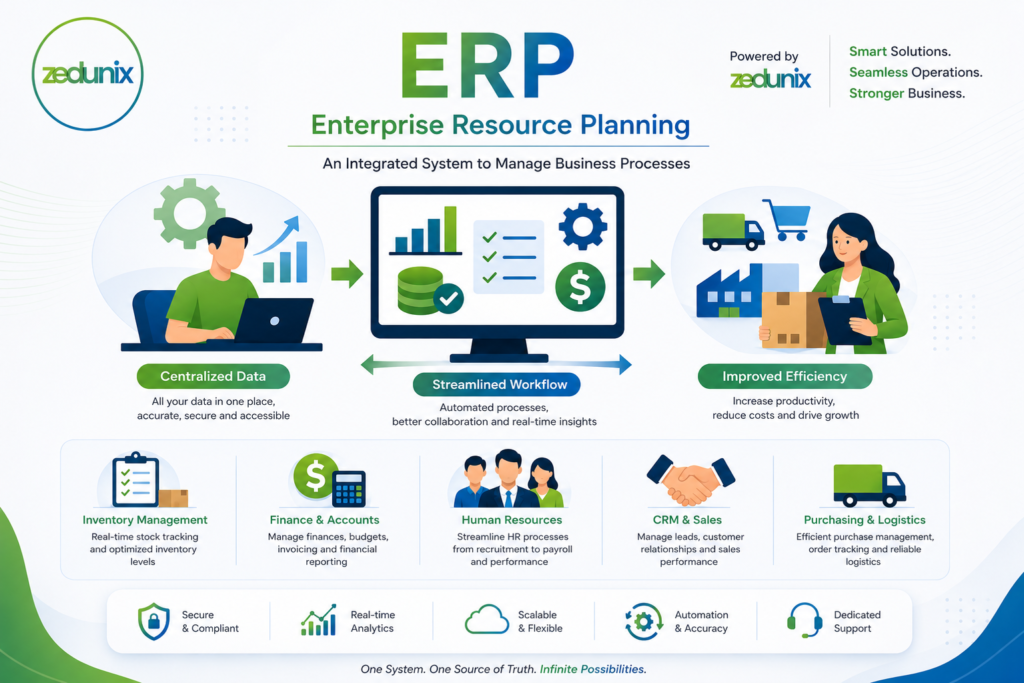
A modern ERP system brings finance, inventory, HR, procurement, sales, and compliance into one connected platform. Instead of five tools talking past each other, there’s one shared source of truth.
For a UAE business specifically, this matters because of how tightly regulation is woven into daily operations — VAT returns, e-invoicing requirements, corporate tax filings, WPS (Wage Protection System) payroll compliance, and free zone reporting all need accurate, real-time data. A disconnected system makes that harder than it needs to be.
Head-to-Head: The Practical Differences
Data visibility. Traditional setups mean checking multiple systems to get one answer. ERP gives every department a live, shared view — critical when a Dubai HQ needs the same numbers as a branch in Abu Dhabi or Sharjah in real time.
Regulatory compliance. UAE VAT, corporate tax, and e-invoicing rules change frequently. Traditional tools require manual updates and cross-checking. Most ERP platforms sold in the region now build UAE-specific tax logic directly into the system, reducing filing errors.
Scalability. A single-location trading company can run comfortably on spreadsheets and a basic accounting tool. The moment that business opens a second branch, adds an e-commerce arm, or expands into a new emirate or GCC market, traditional tools start cracking under the pressure. ERP is built to scale with that growth.
Cost. This is where traditional tools still win, at least early on. Spreadsheets and standalone software are cheap or free. ERP requires licensing, implementation, and training costs — though cloud-based ERP (SaaS pricing) has brought this down significantly for UAE SMEs in the last few years.
Decision-making speed. Traditional systems mean pulling reports manually, often days after the fact. ERP dashboards give leadership real-time insight, which matters in a market like the UAE where business cycles — tourism seasons, trade flows, retail peaks around Ramadan and holidays — move quickly.
Human error. Manual data entry across disconnected tools is where most costly mistakes happen — duplicate invoices, missed stock reorders, payroll errors. ERP automation cuts this risk substantially.
So, Which Is Actually Better?
There isn’t a universal answer — it depends on business size, complexity, and growth stage.
Traditional management still makes sense for:
- Very small businesses or solo entrepreneurs with simple, single-location operations
- Startups still validating their business model, where flexibility matters more than structure
- Businesses with tight upfront budgets and low transaction volume
ERP becomes the better choice for:
- Companies operating across multiple emirates, free zones, or GCC countries
- Businesses with more than one revenue stream (retail plus e-commerce, or trading plus services)
- Any company that has outgrown manual VAT/tax reconciliation
- Organizations where finance, HR, and operations teams are large enough that miscommunication is costing time or money
- Businesses preparing for investment, acquisition, or an IPO, where clean, auditable data is non-negotiable
The UAE Context Tips the Scale Toward ERP — Earlier Than Businesses Expect
What makes the UAE different from many markets is regulatory density combined with growth speed. A company can go from a single Dubai office to a multi-emirate, multi-currency operation within a couple of years. Waiting until the “traditional” system breaks down is usually more expensive — in lost time, compliance risk, and rework — than migrating to ERP a year or two earlier than feels necessary.
For most growing UAE businesses, the real question isn’t “ERP or traditional” — it’s “when.” And increasingly, the answer is: sooner than they think.
Key Takeaways
- Traditional business management works well for small, single-location, low-complexity operations
- ERP consolidates finance, HR, inventory, and compliance into one connected system
- UAE-specific regulations (VAT, corporate tax, e-invoicing, WPS) are easier to manage inside ERP than across disconnected tools
- The decision point is usually growth stage and complexity, not just company size
- Cloud-based ERP has made the switch far more affordable for UAE SMEs than it was five years ago
How Zedunix Fits In
This is exactly the gap Zedunix is built to close for UAE businesses. Rather than forcing companies to choose between rigid, one-size-fits-all ERP and a patchwork of disconnected tools, Zedunix combines ERP, CRM, AI, and automation into a single platform designed around how regional businesses actually operate — multi-emirate, compliance-heavy, and fast-moving. For a company weighing whether it’s “too early” for ERP, that combination often means the transition costs less and pays off faster than expected.
If your business is somewhere between spreadsheets and full-scale ERP, it’s worth a conversation with the Zedunix team about what a right-sized rollout looks like.