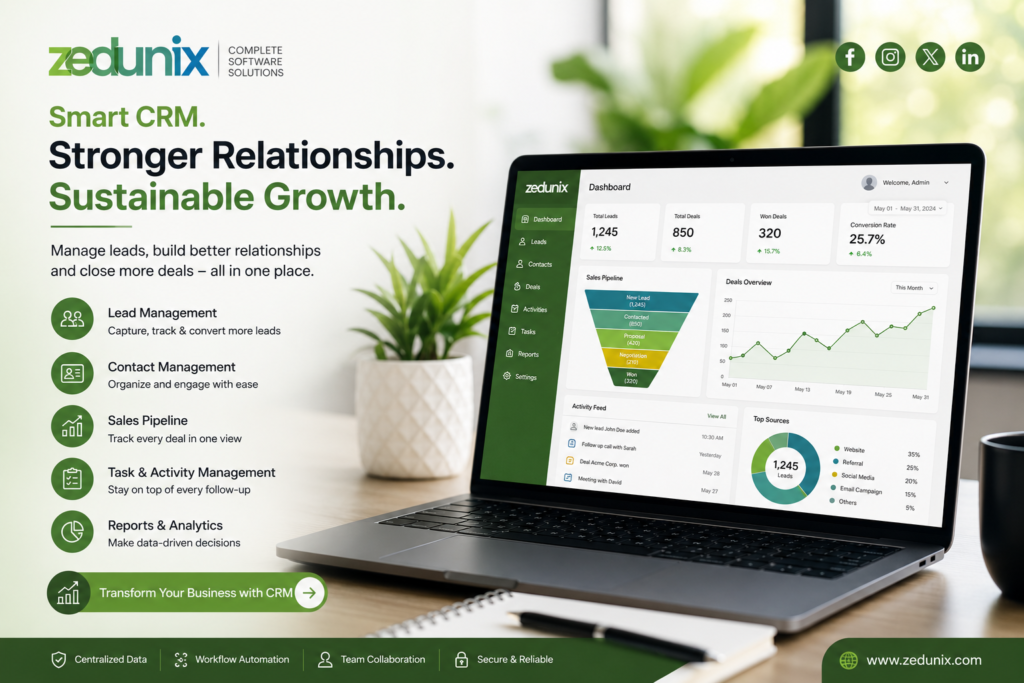
CRM software helps growing UAE businesses centralize scattered customer data, automate WhatsApp and email follow-ups, and generate the auditable records needed for VAT and Corporate Tax reporting. With SMEs representing 94% of the UAE business landscape and cloud CRM adoption accelerating fast, it’s shifted from a nice-to-have into standard infrastructure for any company serious about scaling in the Emirates.
Introduction
The UAE’s SME sector is large and getting more digital by the year. Over 557,000 SMEs now contribute roughly 63.5% of the country’s non-oil GDP, and free zone authorities like RAKEZ have started subsidizing CRM adoption directly — RAKEZ struck a deal with Zoho in early 2026 offering registered businesses up to USD 1,000 in platform credits specifically to lower the barrier to entry. That’s a strong signal: CRM is no longer viewed as an enterprise luxury in the UAE, it’s being treated as core small-business infrastructure.
Yet most growing companies still run customer relationships through a patchwork of spreadsheets, personal WhatsApp numbers, and email threads. In a market where deals move fast and customer expectations around responsiveness are high, that patchwork approach quietly costs revenue — missed follow-ups, duplicate outreach, and no clean audit trail when it’s time to report VAT.
This guide breaks down why CRM adoption is accelerating across the UAE, what’s actually driving it, and what to look for before choosing a platform.
What is CRM Software?
Customer Relationship Management (CRM) software is a business application that centralizes customer data — contact details, communication history, deal stages, and preferences — in one system that sales, marketing, and support teams can all access in real time, instead of hunting through separate tools.
The UAE CRM Market, in Numbers
A few figures explain why CRM adoption is moving quickly in the UAE right now:
94% of UAE businesses are SMEs, and CRM/email marketing typically account for only 5–10% of their digital marketing budgets today — a share expected to grow as adoption normalizes.
The UAE’s CRM market is forecast to grow at roughly a 10.84% CAGR among SMEs through 2031, driven by lower entry barriers rather than a sudden shift in intent.
80% of UAE enterprises already report using cloud services, and the country’s cloud computing spend is projected to reach AED 12 billion, both fueling demand for cloud-based CRM specifically.
Implementation costs in the UAE range widely — roughly AED 60,000 to AED 550,000 depending on complexity — which is why SME-friendly, subscription-based platforms (Zoho, HubSpot, Odoo) are gaining ground faster than heavier enterprise systems.
70% of UAE companies cite data privacy as a major concern in CRM adoption, tying platform choice directly to PDPL (UAE Personal Data Protection Law) compliance.
Regionally, UAE companies adopting AI-powered CRM tools are seeing meaningfully faster ROI and lead-generation speed than typical EMEA benchmarks, as vendors like Salesforce and Odoo roll out GCC-specific AI features.
The pattern is consistent: adoption is being pulled forward by cost accessibility, cloud infrastructure, and compliance pressure — not just competitive pressure.
Why This Matters More in the UAE Than Elsewhere
A few structural realities make CRM adoption more urgent for UAE businesses specifically, not just useful in the abstract:
WhatsApp is a primary sales channel, not a side channel. Customer conversations that start on WhatsApp Business need to be logged and followed up systematically — not left in a salesperson’s personal phone.
Bilingual operations are the norm, not the exception. Arabic and English-speaking customers are often served by the same team, and communication history needs to stay consistent regardless of language.
Multi-entity structures are common. A single company may operate across a free zone entity and a mainland entity, or across multiple emirates — a cloud CRM keeps records unified instead of fragmented by location.
Compliance has real teeth now. With Corporate Tax and VAT enforced through the Federal Tax Authority, and PDPL governing how customer data must be handled, organized digital records aren’t just convenient — they’re part of doing business defensibly.
Key Features UAE Businesses Should Prioritize
Contact management — a single, centralized record of every customer’s details, history, and preferences, accessible instantly across teams.
Sales pipeline management — lead tracking, deal stages, forecasting, and automated follow-ups, particularly valuable for the longer B2B sales cycles common in UAE real estate, logistics, and professional services.
WhatsApp Business integration — the single highest-leverage feature for UAE teams, since it turns an unstructured messaging channel into a trackable, automatable part of the sales pipeline.
Lead management — capturing and prioritizing leads from property portals, Instagram/TikTok campaigns, trade events like GITEX, and referral networks.
Support ticketing — tracking inquiries and response times, which matters in a market where reputation moves fast through Google reviews and word-of-mouth.
Reporting and analytics — real-time dashboards on pipeline health, conversion, and retention, useful both for internal decisions and for reporting to investors or parent companies abroad.
Benefits Specific to Growing UAE Companies
Centralized bilingual records keep Arabic and English customer history consistent across teams. Automated WhatsApp follow-ups match how UAE customers actually expect to communicate. Audit-ready records support FTA VAT and Corporate Tax documentation. Multi-entity visibility keeps free zone and mainland operations aligned. Faster sales cycles create a competitive edge in a fast-moving, relationship-driven market. PDPL-aligned data handling reduces the compliance risk 70% of UAE companies say they’re worried about.
Industries Seeing the Fastest UAE CRM Adoption
Real estate, retail and e-commerce, hospitality, financial and professional services, healthcare, logistics and trading, education, automotive, and construction are the sectors where CRM adoption is moving fastest — largely because these industries combine high lead volume with long or repeat sales cycles, where manual tracking breaks down first.
Signs Your UAE Business Needs a CRM Now
Customer data lives across spreadsheets, personal WhatsApp numbers, and inboxes. Follow-ups are inconsistent or dependent on one person remembering. Marketing-to-sales handoffs regularly drop leads. Preparing VAT or audit documentation from scattered records takes days, not minutes. Teams across different emirates or entities can’t see the same customer data.
Choosing a CRM: What Actually Matters in the UAE
Look for native WhatsApp Business API integration, a bilingual interface and reporting (Arabic/English), PDPL-aligned data handling and access controls, cloud-based hosting with clear data residency information, a reasonable total cost of ownership relative to SME budgets, and integration with UAE accounting and e-invoicing workflows given upcoming e-invoicing mandates. Most UAE SMEs should be evaluating subscription platforms in the low-to-mid range, not six-figure AED enterprise deployments.
Conclusion
The numbers tell a clear story: UAE CRM adoption isn’t being driven by hype, it’s being pulled forward by free zone incentives, cloud cost reductions, and compliance requirements that make disorganized customer data a genuine business risk. For a growing UAE company, the question isn’t really whether to adopt a CRM anymore — it’s which one fits the way the business actually operates: bilingual, WhatsApp-first, and increasingly answerable to the FTA.
That’s the gap Zedunix was built to close — WhatsApp-first workflows, bilingual records, and FTA-ready reporting, built for how UAE businesses actually work.
Talk to the Zedunix team today and move from scattered data to a single, compliant source of truth.